What if our postal system worked like the subway?
Before the internet sent emails in seconds, cities used a system called Pneumatic Tubes to send mail and tiny packages to post offices almost instantly. Cities such as Berlin, Paris, and New York used these tubes to send mail at a rate of up to 35 miles per hour to post offices across the city. Think “The Jetsons.” These tubes would use pressurized air to push objects within a tube at incredible speed.

The pneumatic tube was invented in 1799 by Scottish chemist and inventor named William Murdoch. Due to its compact nature and its future forward mechanism, this invention was widely adopted by postal systems around the world.
Thanks for reading! Subscribe for free to receive new posts and support my work.
New York laid miles of pipes below the city to transport mail between postal offices. St. Louis, Chicago, Boston, and Philadelphia also operated pneumatic tube systems. These canisters could hold up to 600 letters and travel at an average of 35 miles per hour.
Before digital receipts, department stores employed this system on a micro scale. When buying an item, a sales associate would stuff the money and paperwork in a tube and place it in a pipe. Within seconds air would suck it up. After one to two minutes, a receipt and a parcel would be dispensed in an adjacent pipe.
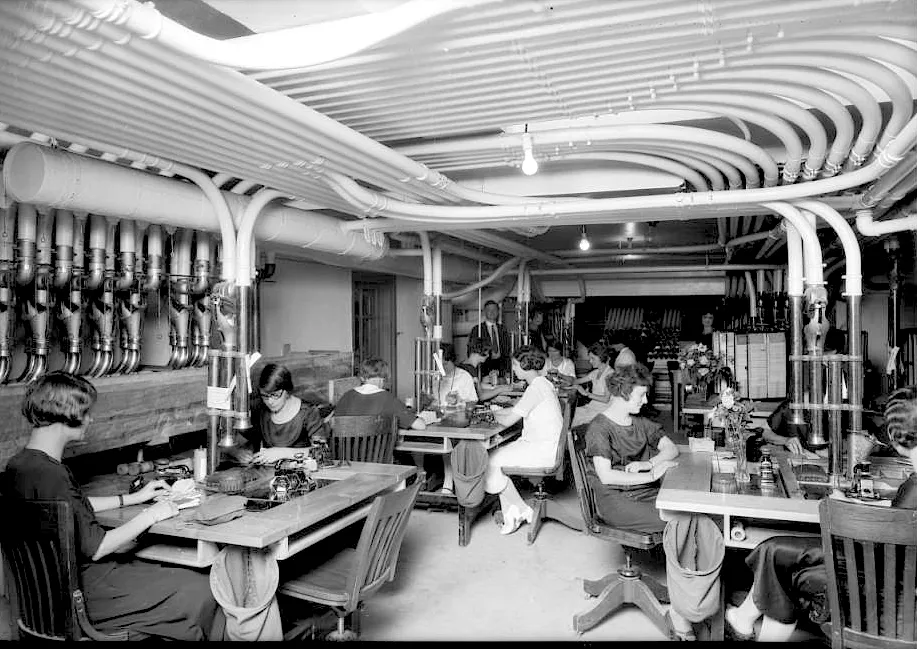
City planners thought that this would become the next method of transportation. Instead of subway cars, they imagined tubes whisking people to destinations in a matter of minutes. However, they soon realized it was too impractical and subway cars became the future instead.
Today, hospitals use pneumatic tubes to transport in-patient blood samples to the labs. Each station has a code which you type in, then the system works out a special path to get the tube to its final destination so it doesn’t collide with other samples.
The futuristic scenes that you see in movies with people being shot through air tubes aren’t that far off. But, unlike a small envelope or telegram, transporting people through these tubes is a lot less practical.
Could work this work on a much smaller scale? What if the elevators in the malls were replaced with amusement park like elevators where they could whoosh you from one floor to the other? Or, what if an underground network of tubes delivered packages and groceries straight to your home? Comment below other ways you think the tubes could be reimplemented in today’s society.
Sources
http://douglas-self.com/MUSEUM/COMMS/pneumess/pneumess.htm